
English translation of « Automate asocial et systèmes acentrés », Communications, no. 22, « La nature de la société », 1974, pp. 45–62 (doi:10.3406/comm.1974.1337). The original French text is reproduced alongside. Page numbers of the printed edition are given in the margin; footnotes, numbered by page in the original, are numbered continuously here. The figures are the original artwork, with French labels; translated captions are given beneath them.
Introduction
45The authors make a case for the language of acentrism.
It would be simplistic to think that the hierarchical concepts imposed by those who exercise power genuinely correspond to the nature of things. Biological organisms, animal “societies”, as they are called, and human “hordes” of every kind reveal, on closer inspection, centres more or less everywhere, or, in the limiting case, an absence of any centre. The history of artificial organisms is revealing too. Driven by the prevailing myth of hierarchy, the first architects of electronic machines conferred all power on a single central organ. Ironically, however, this central organ very quickly became congested, and one began to dream of an acentric computing factory, rather like the brain, which would perform numerous operations in parallel, spread over a vast terrain, on the basis of local initiatives whose coordination would remain to be devised. Equally symptomatic is the present confrontation of our technological society with hypercentralised automatic information systems: when these are introduced into increasingly deep levels of social life, as in police files on persons, the social body rejects them as asocial intruders.
To assist in conceptualising acentric systems, the authors turn to a notion from the theory of algorithms: networks of finite automata. Since the aim of this article is to unsettle the imagery of command trees, the mathematical discussion into which we venture here will make no great technical claims, but will serve rather as a hygienic metaphor, the limits of which will, moreover, be discussed in conclusion.
1. Two theorems of dictatorship
Let us begin with the antithesis, by setting out two famous problems whose solutions may seem rather disappointing.
46a. The friendship theorem (Erdős, Rényi, Sós)1.
A society consists of a set of individuals , , , ..., on which a relation of friendship is defined, obeying only the following axioms:
- I.
- If is a friend of , is a friend of ( and are thus either friends of one another or not friends).
- II.
- Any two individuals (whether friends or not) have exactly one friend in common.
We ask under what conditions such a society exists, and what form its friendship network takes.
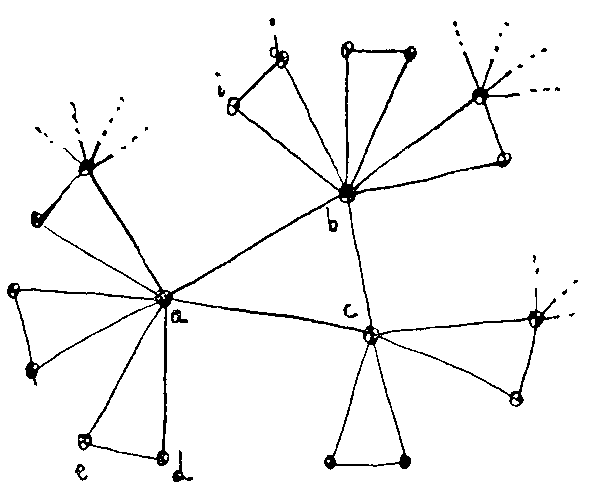
We can proceed by trial and error. Consider an individual . This individual has a certain number of friends , , , , ... Let be one of these; by (II), and have a common friend, for example; similarly, and have a common friend, distinct from and by (II), for example, and so on. It follows that the friends of are even in number and organised in pairs of friends , , ... Let us, for instance, give four pairs of friends, as shown in figure 1, and we already have an example of a society satisfying the axioms.
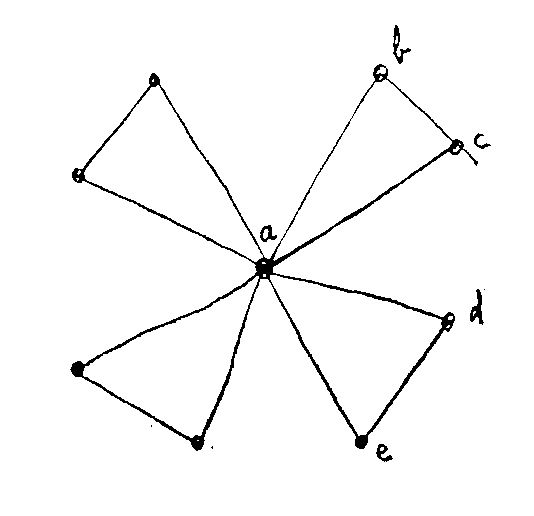
But can , , , , ..., in turn, like , have more than two friends? This is what we attempt to sketch in figure 2. For example, would have as friends , , , , ..., which leads us to add further individuals (in addition to those shown in the figure): the common friends of and , and , and , and , ...; let , for example, be the common friend of and ; and have a common friend who is neither nor ; is therefore itself surrounded, like and , by more than two friends. Ultimately, it appears that each individual to be added to figure 2 would have to be connected to a friend of , and respectively, all three distinct from these, and that these added individuals would also have to be suitably connected to one another. Can this be done? Here intuition fails us; with a little mathematics2 one proves that it will not be possible to construct such a society. Hence the friendship theorem:
If in a society any two individuals have exactly one friend in common, then there exists an individual who is a friend of all the others.
In other words, the friendship graph is necessarily of the type shown in figure 1, and not of a uniform type, as we were attempting to conceive in the reasoning based on figure 2.
Let us leave it to sociologists to find a label for the universal friend of this society of pairs: master, confessor, physician ... ideas strangely far removed from the initial axioms.
b. The theorem of collective indecision (Arrow)3.
A society sets out to make collective choices reflecting the preferences of all its individuals. More precisely, it is a question of ranking a finite number of proposals, say A, B, C, ..., which the individuals have already ranked, each according to their own individual preference; the set of these individual opinions constitutes 47
48what is called a state of opinion. The collective choice must be derived from the state of opinion according to a rule established once and for all. Naturally, the rule is expected to reflect4 the state of opinion; more precisely, it is required to satisfy two axioms:
- I.
- axiom of collective sovereignty: the rule excludes no collective choice a priori,
- II.
- axiom of fairness towards individuals: if, for a given state of opinion, the rule concludes that A is collectively preferred to B (to take an example), then for any change in the state of opinion in which those who individually preferred A to B continue to do so, A must remain collectively preferred to B.
Consider a rule obeying both axioms. We call a decisive group for the preference of A over B (we say for the ordered pair (A, B)) a non-empty set of individuals which is the set of individuals who prefer A to B individually, in a state of opinion for which the rule concludes that A is collectively preferred to B.
It is then proved that:
- a)
- The collectivity is a decisive group for every pair of proposals (unanimity),
- b)
- any decisive group for one pair of proposals is decisive for every other pair and therefore constitutes a dictatorial core,
- c)
- for every partition of a dictatorial core, and of the collectivity in particular, into two groups, one of the groups is a dictatorial core.
It follows that there is a dictatorial core consisting of a single individual. Hence the dictatorship theorem:
A society which imposes the axioms of collective sovereignty and of fairness towards individuals on its rule of collective decision is a society under a dictatorial regime, that is, one which identifies every collective choice with the individual preference of one of its members, chosen once and for all.
2. Fluidity and acentrism
The two theorems above show that certain problems of organisation, whose formulation is entirely non-hierarchical, admit as their sole solution an entirely hierarchical one.
Their social significance must not be exaggerated, still less, obviously, should they be invoked to vindicate a natural centralisation. On the one hand, they proceed from rather rigid axioms (the uniqueness of the common friend and the uniqueness of the rule for every state of opinion5), which poorly reflect real situations. On the other hand, it is easy to exhibit theorems of “perfect democracy” as well. We shall come to these in the next section.
It is undeniable, however, that the customary practice is to regard the notion of centralisation as a kind of necessary correlate of the notion of system or organisation, 49and this practice no doubt stems from the difficulty we have in conceiving of the regulation that ensures the coherence and stability of a social form. To accept the primacy of hierarchical structures is to privilege arborescent structures, to consider that the circulation of information must unfold like a river (against the current in the case of directive information).
The arborescent form can be made explicit topologically. As R. Thom indeed notes, strict centralism (that of “military societies” in which a single leader commands subordinates who are all equivalent) is the simplest solution to the problem of the stability of societies considered as “metabolic” forms (endowed with regulation). It can be described as follows: “Each individual occupies a determinate position within it and regulates their movement so that the overall form of the society is preserved, as is their position in the whole. It is clear that the global invariance of the spatial body requires permanent interaction between each individual and the individuals surrounding them. Since the circulation of information, considered as a fluid, must be structurally stable, the simplest way to achieve this is to make it a gradient flow; a positive function , authority, will be defined on the social body, vanishing at the boundary, and each individual will be required to regulate their movement according to the nearest individual situated on the trajectory of the gradient of , for higher values of 6. The function must have at least one maximum7; the individual situated at this point is the leader, because they can take directives only from themselves. Since delays in the transmission of directives can have a disastrous effect on global stability, the function cannot admit any critical point other than the maximum personified by the leader. It follows that the social body is a ball8, subject to monarchical direction9.” If the flow is a gradient flow, with a trajectory proceeding in the direction of decreasing potentials, there can be no closed trajectories.
If we pass from the continuous representation evoked here to a discrete representation, this property becomes characteristic of arborescent structures, since, by definition, a tree is a (connected) graph without cycles.
The following observations can be made about the arborescent model:
- I.
- In any system an individual regulates their movement only in relation to their active “neighbours”, that is, those liable to transmit directives to them; yet in a hierarchical system the individual admits only one active neighbour, their hierarchical superior. In their behaviour, therefore, an individual disregards any alter ego on the same level.
- II.
- In a hierarchical system the channels of transmission are pre-established: the tree precedes the individual, who is incorporated into it at a precise position, a functional position.
- III.
- 50The only individuals who are interchangeable are those on the same level and, dually, the channels of transmission connect individuals whose functions are discernible.
At the opposite extreme from military societies are the so-called “fluid” societies, the simplest example of which is a cloud of mosquitoes: “Each individual in the group moves randomly until it sees all its fellows in the same half-space; it then hastens to alter its movement so as to re-enter the group. Here, stability is ensured ‘catastrophically’ by a barrier that ensures a discontinuity in behaviour10.” Note that in such a cloud:
- I.
- Each individual regulates its movement in relation to numerous occasional “neighbours”, all of whom are its alter egos.
- II.
- The neighbourhood relation is fluid, and no network pre-exists the individuals.
- III.
- All individuals are interchangeable.
- IV.
- The regulation ensuring the stability of the system requires a certain statistical density of individuals.
A hierarchically organised human society is obviously neither fluid nor military. It is intermediate and admits both types of regulation. All the individuals hierarchically dependent on the same decision-making centre form (together with that centre) a “ball subject to monarchical direction”, and together (excluding the centre) they form a “cloud”. To guarantee the overall stability of the system, that is, to exclude any possibility of a cycle, each cloud must therefore be separated by a kind of shock wave both from the other clouds and from the other levels. The discontinuities in behaviour which “catastrophically” ensure the stability of the various clouds are produced by ideology and maintained by repression. This means that hierarchical societies are, so to speak, locally fluid11.
Having briefly described the general morphology of a hierarchical society, we must now study its performances. A performance is a regulated set of operations carried out in response to the circulation of information. In a locally fluid society the situation can (ideally) be described as follows. Given a cloud, each of its individuals operates on the basis of a distribution of tasks originating from the associated decision-making body, which gathers together and totalises the partial results. These results are produced independently of one another.
The theory of acentric systems (networks of finite automata) aims to provide models of abstract organisations more subtle than locally fluid organisations, by making explicit the extent to which global results can be achieved without recourse to any centre by a cloud, provided that it has a minimum of organisation (as a connected network). The individuals no longer operate independently of one another, but regulate their movement according to the information they receive from their “neighbours”.
In an acentric system the circulation of information is defined by a graph and differs from hierarchical circulation in two respects:
-
the graph has no reason to be a tree; indeed, it may be arbitrary;
-
51each line of information is bidirectional;
-
the individuals are all interchangeable.
We see, then, that the primary difference between a centred and an acentric system arises from the fact that graphs other than trees are permitted. The system will be completely acentric if the vertices of the associated graph are indiscernible.
3. The Firing Squad theorem
We shall explain the operation of networks of finite automata by starting from the famous Firing Squad problem, whose mathematical history has had many twists and turns, culminating in a definitive victory of acentrism over hierarchy.
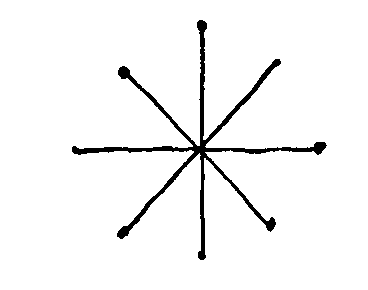
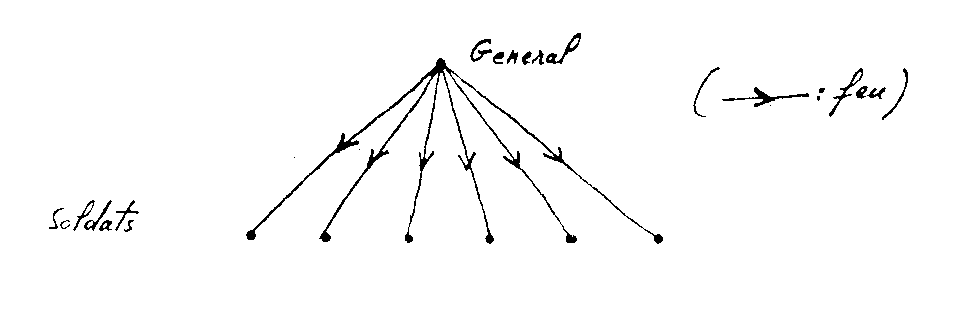
Consider individuals (soldiers) arranged in a line, whom we wish to bring all together (at the same unit of time) into the “fire” position (we shall call it the “fire” state), a position new to all (none must have assumed it during any earlier unit of time). The obvious solution suggested by the title of the problem is to introduce a general, a decision-making centre external to the line, giving a common order as shown in figure 3. This situation has been sufficiently discussed above.
52In 1964 E. F. Moore12 proposed placing the general at the end of the line, with each soldier communicating only with their neighbours in the line, and only one of them communicating with the general. Each soldier (identical to every other soldier) would choose, at each unit of time, a state from a finite set of states; this choice would be made according to a systematic rule (transition rule), taking into account only the present state of the soldier and of their neighbours (or of their single neighbour, for the soldier at the end of the line). Mathematically, the soldier has become a finite automaton. At time 0 the soldier is asleep. Only the general awakens and initiates communicative activity among the soldiers (in a state other than the “fire” state, moreover, since the general, too, will have to enter that state only once). The conjecture, then, was whether, as the number of soldiers increased, the problem would remain solvable with a constant number of states, that is, with an individual of fixed intelligence (independent of )13.
In 1966 a very complex but finite solution to this problem was proposed; in 1967 R. M. Balzer14 proposed a solution with only eight states, which, to our knowledge, was never proved to be minimal; and in 1966 one of the authors15 proved that the problem could dispense with a general at the end of the line, and even with the arrangement in a line: in any connected network organisation, in which any automaton can serve as initiator, the synchronisation problem remains solvable by a very elementary finite automaton.
Let us make two observations about the acentric Firing Squad problem:
- I.
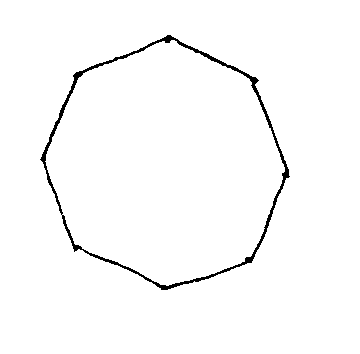
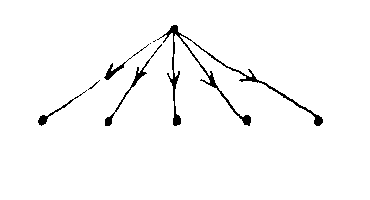
- The graph governing the circulation of information is in a sense the opposite of the hierarchical graph (see figure 4). At every time , an automaton reads the state of its neighbours.
- II.
- 53The fact that an automaton at the initial time takes the initiative in activating the collectivity in no way implies the reintroduction of a hierarchy. On the one hand, the problem is indeed solvable for any graph and any initiator; on the other hand, an acentric network can be conceived so as to solve several problems at once, starting from different initiators.
- III.
- Time is discrete: if an automaton is the initiator at time , another automaton is asleep until time , where is the length of the shortest path from to the initiator; the total computation time is a function of the number of automata in the network, and is obviously at least for a line of automata.
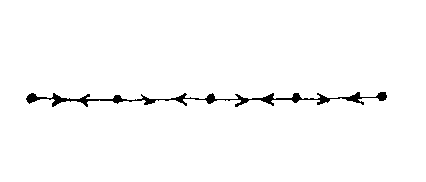
Let us work out a solution for a line of automata. The principle is to “mark” the one or two automata at the midpoint of the line, then to do the same on each of the two half-lines, and so on, until all the automata are simultaneously, for the first time, marked and surrounded by neighbours which are all marked. They then enter the “fire” state.
To construct marks, let us imagine the concept of a signal propagating at speed ( an integer) along a path: an automaton on the path is in state , which becomes at the next time, then , ..., and finally . It then imposes state on the next automaton along the path, and so on. It is quite clear that finite automata can transmit signals at every speed . It is easy to construct transition functions having this property. Note the obvious property: if a signal of speed 1, starting at one end of the line and bouncing back from the other end, is followed at the starting point by a signal of speed 3, the two signals meet at the midpoint of the line.
We suppose that each automaton on the line is capable, once suitably excited, of emitting signals of respective speeds 1, 3, 7, ..., , ... to its right and, where appropriate, to its left16. Let us then call it an “emitter”. At time one end of the path (the general) will be an emitter. The automata will then observe the following two rules:
- a)
- When a signal reaches an end of the path, that end becomes an emitter.
- b)
- Where two signals meet, one or two emitters appear (depending on whether the crossing occurs at an automaton or between two automata).
- c)
- When every automaton is an emitter and has all its neighbours as emitters, the next time is that of the “fire” state.
It is then observed that the “fire” state appears at time .
54In figure 5 we represent the case of a line of five automata.
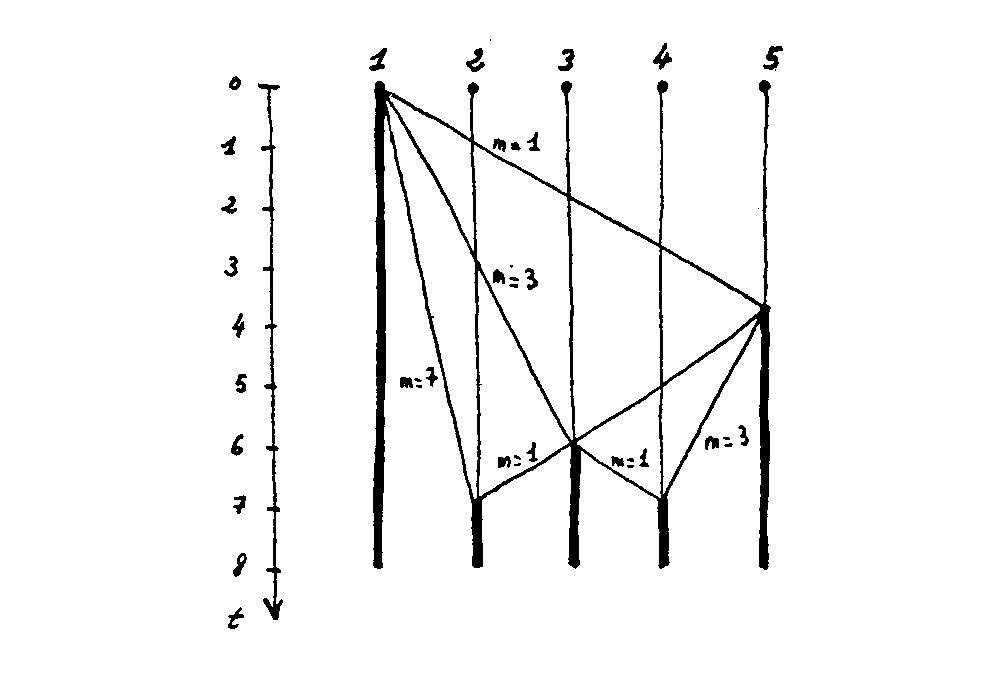
Let us now work out a solution of the Firing Squad problem for a circle of automata, say eight, using only the two signals and , of respective speeds and .
The automata (still capable of becoming emitters) will observe the following rules:
- a′)
- Where two identical signals meet, one or two emitters appear, sending the same signal back in both directions.
- b′)
- Where two different signals meet, one or two emitters appear, sending both types of signal back in both directions.
- c′)
- When every automaton is an emitter and has its two neighbours as emitters, the next time is that of the “fire” state.
Then, as can be seen in figure 6, at times
: 1 is an emitter,
: 5 becomes an emitter,
: 3 and 7 become emitters through the crossing of distinct signals,
: 2, 4, 6 and 8 become emitters,
: “fire” state.
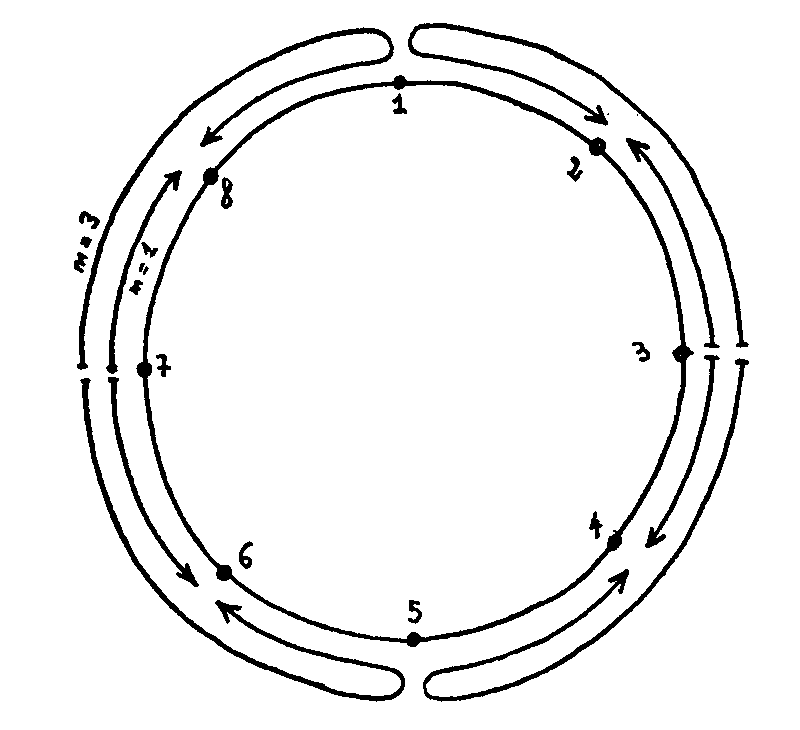
Let us formulate, on the basis of the examples above, some characteristics of networks of finite automata:
- I.
- The network as a whole is the site of an autonomous computation, neither programmed nor directed by a central body. The computation is performed “in parallel” by the automata. Of course, all the intelligence is pre-established in the standard automaton, but its reduced form may suggest certain spontaneous psychological processes.
- II.
- The elementary intelligence is standard and depends not on the network itself but on the problem to be solved. We can imagine automata with limbs (automata of degree ) released into the universe, connecting their limbs at random to other automata of the same type to constitute a network. We say that an automaton “reads”, through one limb, the state of the limb to which it may be connected.
- III.
- The number of vertices and edges in the network is not limited; only the maximum degree of each vertex is part of the structure of the automaton. Any removal or addition of automata or connections is possible. Automata which, for a given problem, can tolerate a modification of the network during computation are particularly interesting.
56An automaton is defined by: limbs numbered from 1 to , a set of states identical for each limb, and a transition function which defines, for every state at time of the limbs of and of the limbs (belonging to other automata, for example) connected to them, the state of the limbs of at time .
A family of automata of type constitutes a network R if the limbs of the automata are connected in pairs or remain dead; the network is then either connected or not, and of degree at most . Let G be the graph thus constituted.
It is legitimate to ask whether a graph problem17 (finding a spanning tree, the centres, a diameter, a Hamiltonian cycle, etc.) can be solved by an algorithm carried out by standard elementary intelligences placed at the vertices of G, operating in parallel and displaying the result in the very place where it is found, the memory of the computations being embedded in the structure which is itself the object of the computation.
A problem will be called “solvable by a network of finite automata”18 if there exists a finite automaton such that the assembly of an arbitrary number of copies of into an arbitrary network, placed in the initial state of sleep with the exception of one of them chosen arbitrarily as initiator, evolves towards a stationary state which displays the solution of the problem.
The identification of problems solvable by a network of finite automata is an open problem, currently the subject of various conjectures.
The following result can be established easily: the construction of a spanning tree of a connected graph is solvable by a network of finite automata with five states per limb. In a connected graph there are generally several spanning trees; the arbitrary selection of one of them is accomplished by means of the arbitrary numbering of the limbs of each automaton.
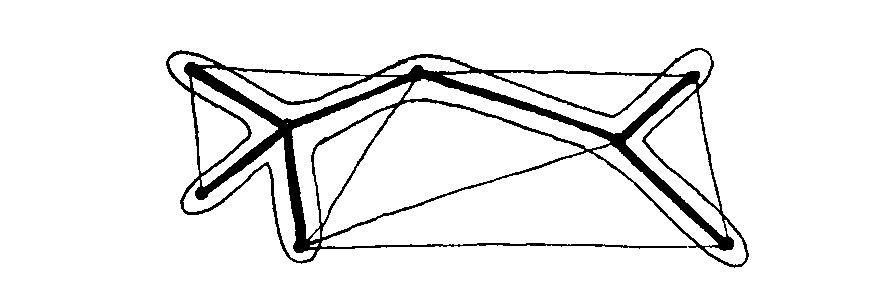
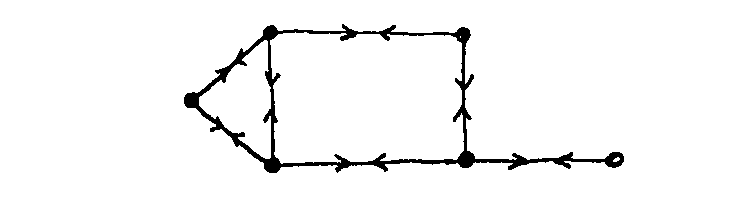
57Once the spanning tree problem is solved, little needs to be added to the automaton that solves it in order for it to establish a circular walk around this tree, as shown in figure 7.
We finally arrive at one of the results sought: we know how to associate with any graph a circular walk passing at least once through every vertex. Now the Firing Squad problem was solved above for a circular walk with an arbitrary initiator; it is therefore solved for an arbitrary graph with an arbitrary initiator.
A more complete description of the solution would lead us to “stack” automata having the various required functions, transmitting their states to one another with appropriate time offsets. Parallelism then governs the computation entirely, since the stacked automata simultaneously work out the construction of the tree, of the circular walk, and of the Firing Squad signals and along the circular walk.
4. Acentric organisation of a society of words
Networks of automata deal essentially with the logistical aspect of organisations. They make it possible to solve apparently very complex problems of autonomy of communication by “localising” algorithms from graph theory. This is why they play a role in the study of artificial intelligences and pattern recognition.
We shall present a recent study in semantics by J. Fiksel19. The question is as follows: to find a plausible model of the psychological activity ensuring a yes or no answer to a question (of predicative structure). To this end, we posit a memory in which information is recorded and a “control terminal” which poses the question, i.e. which gives a search command and answers on the basis of the work carried out in the memory. We shall see that what is involved is in fact the acentric organisation of a certain society of words.
The memory is described as a labelled directed graph , where the vertices (X) are labelled with terms of the language and the arcs (E) with relations (belongs to, has as a part, etc.). We suppose that, in the set T of these relations, each element admits a formal inverse . To take up Fiksel’s example, we can consider the “zoological” memory in figure 8, where E, C, H are the relations element of, subset of, has as a part.
Note that not all the possible relations between terms are recorded (the relation “robin wings”, for example, is missing).

We can transform G into a network of automata as follows. If is the degree of G, we place at each vertex of G a copy of an automaton with limbs (some of which may be dead). If the limb of vertex and the limb of vertex are connected, and if the associated directed arc is labelled with , we label with and with . We thereby define for 58
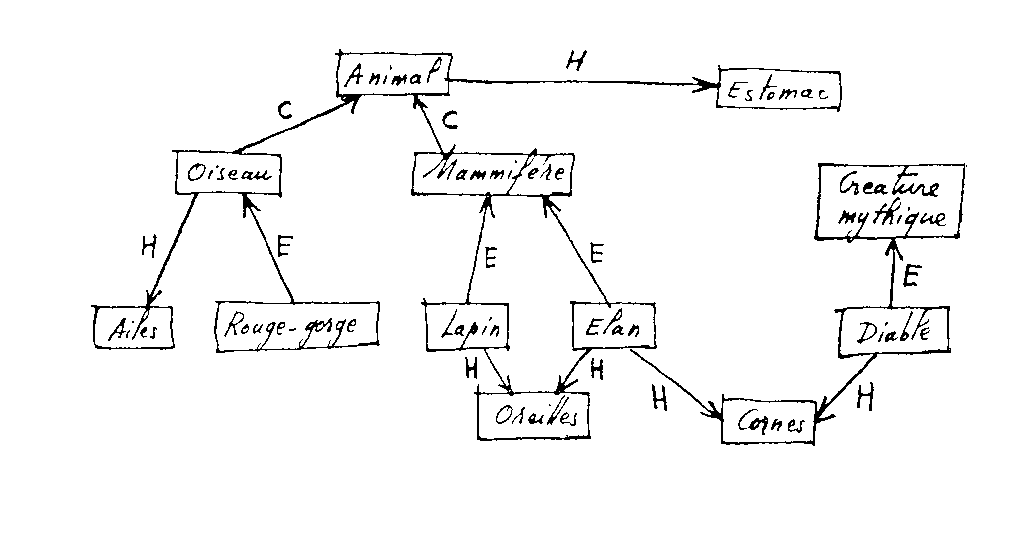
each automaton a relational vector . (To dead limbs we assign the empty relation .)
The reading of automaton then consists of this vector and of the states of the limbs of the neighbouring automata connected to those of .
To connect the semantic memory to the terminal, we add to each automaton a limb connected to the terminal, whose states and inputs are (I, 0, 1, 2): I is the idle state; the terminal sends an excitation of type 1 (or 2) to automaton when the reading of the limb of is 1 (or 2) for one unit of time, followed by state I; state 0 is used by the terminal to “freeze” the network: when receives 0 from the terminal, it stops all computation until it receives I, in which case it returns to the idle state.
A “question” is then a triple , where and is a relational sequence of elements of T. We denote by the set of sequences for which . An “answer” is a path in G from to composing the sequence . It is then a matter of finding an automaton which performs the search for such a path locally. The search could obviously be carried out globally by enumerating all the paths between and . But this is certainly not how a real memory operates: “this type of enumeration would ordinarily require a global intelligence with the capacity to store information in tree-like 59lists. The significance of Theorem 120 is that it shows how this algorithm can be executed using far more limited computational powers; namely, by a network of finite automata in which only local interactions are permitted”.
The local algorithm for finding an answer path in the semantic memory can then be described as follows. Let . The set of states of a limb is (with even), the interpretations being as follows (denoting by the state of limb of automaton at time ):
-
: dead state,
-
I: idle state,
-
: the network has constructed a path starting from , where are the first relations of and corresponds to ,
-
: the network has constructed a path starting from , where are the last relations of and corresponds to ,
-
: is the limb of two paths, one starting from , the other from (which implies ).
This last case is special, as we shall see.
The search for an answer path is then effected by a straightforward procedure of branching from both and , according to the following transition function. (If automaton satisfies none of the initial conditions of the rules below, it remains in its initial state.)
- 1. (a)
- If automaton receives an excitation of type 1 (from the terminal), it places all its limbs labelled in state .
- (b)
- If automaton receives an excitation of type 2 (from the terminal), it places all its limbs labelled in state .
- 2. (a)
- If automaton receives a signal, it places all its limbs labelled in state .
- (b)
- If automaton receives a signal, it places all its limbs labelled in state .
- (c)
- In the special case where automaton simultaneously receives signals and , and if , then places all its limbs labelled or in state . The purpose of the states is therefore to prevent backtracking in this particular case, as in the following example, where and where denotes a connection between limbs.
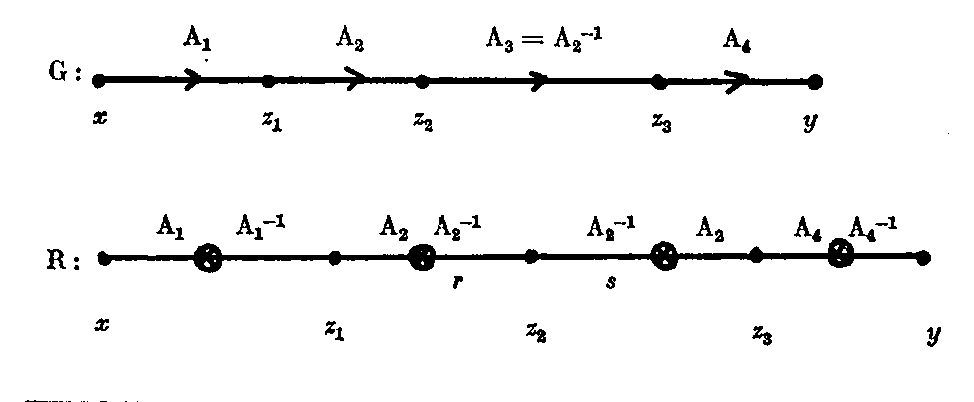
60(On receiving from , should, according to (a), place its two limbs in state . But since it receives from at the same time, it should, according to (b), place its two limbs in state : hence the necessity of state .)
- 3.
- If , then : after transmitting a signal, a limb becomes idle.
- 4.
- Conditions for an answer.
- (a)
- If simultaneously receives a signal and an signal, or
- (b)
- If simultaneously receives a signal and transmits an signal along the same limb, then places its limb in state 1.
The terminal, upon receiving this answer, says “YES” to the question . Note that if , the set of states depends only on , but that on the other hand the transition function depends on .
From this description one can then prove the following:
Theorem 1. Let be a directed graph whose arcs E are labelled by T. For every question with and (the sequences of at most elements of T), there exists a transition function such that, if and are excited by the terminal, the network associated with and G can establish the existence of a path of form between and in time . (If, therefore, after time the terminal has received no answer from the network, it answers “NO”. Since the terminal is a special organ, it knows how to count arbitrarily far.)
Since there can obviously be several paths of form between and , the delicate point of the proof is to show that when two such paths have a common part, signals can traverse these paths without interference. It can even be shown that all the paths between and are constructed and that they supply an answer to the terminal at the same instant.
The importance of such a result for documentary searches, for instance, is readily understood. Given a memory organised as a labelled graph (which may be extremely complex), enumerating the paths would require a considerable central memory, which would, moreover, operate in a “stupid” fashion. What is more, the acentric model is unquestionably more pertinent as a model for theoretical psychology.
This model can, moreover, be refined. On the one hand, it can be shown that by “stacking” a simple marking automaton on top of the search automata, we can not only obtain the answer to a question , but also explicitly identify all the paths of form between and . On the other hand, we can take into account the question of implication. This is necessary insofar as semantic memories are incomplete. In the example we gave, the relation “robin wings” was not recorded. Now, if we pose the question (robin, H, wings), it would obviously be desirable for the terminal’s answer to be “YES”. To this end we introduce the notion of a production.
An elementary production is an operator:
and where the arrow represents a logical implication (here ). This makes it possible to define by generalisation the permitted productions , where and are two sequences of elements of T (i.e. ). To answer a question is then to search for whether there exists, in the semantic memory, a path of form between and such that . Let be the set of these 61paths. may be very large, for the such that have no reason to be distinct. We shall therefore be led to search for the shortest path in . If , the search cannot terminate. The terminal must therefore set a limit beyond which it answers “NO” in the absence of an answer from the network.
It is then proved that the search for the shortest path in (of length ) can be computed by finite automata in a computation time of .
Our excursion into a field of linguistics may have seemed rather remote from the general discussion of societies. It is not. For we have just seen how a collectivity of individuals whose connections are labelled finds, within itself, a chain of given labels if it exists, a chain which may be arbitrarily long, just as the number of individuals may be arbitrarily large.
Conclusion
By way of conclusion, we would like briefly to discuss the metaphorical play made possible by the language of acentric systems. Without minimising the theoretical constructions proposed above, we might say that they concern the logistical level of organisations: “problems of mass communication”. We have solved problems of coordination between cells without coordinators by granting ourselves the strong hypothesis of computability, that is, of the digitisation of information. In other words, the nature of the cells and the problems to be solved have always been reduced to lists of states capable of being represented by numbers (digits), and to rules of state transition that are equally amenable to digitisation.
It is within this framework of strong hypotheses that we have proved, contrary to the belief that sheer numbers breed either disorder or uniformity, that effective coordination can be established within an acentric collectivity of individuals with limited memory, whose number is nevertheless arbitrarily large. But the purpose of our discussion of the subject raised by the journal Communications does not end there.
Let us consider natural acentric systems, such as the anthill and the termite mound. The construction by termites of a sponge-shaped edifice, or the operations of smoothing surfaces performed by ants as described by R. Chauvin21, are without doubt manifestations of acentric systems. It is clear that there is no ant in possession of the “plans” of the anthill. The anthill is a building site without an architect. But if the anthill cannot be recapitulated by an ant, neither can it be recapitulated by a finite automaton, however complex it may be22.
And it is precisely here that the notion of an acentric system finds in reality one of its principal distinguishing features, namely that the activities performed locally by individuals (words, ants, people in a crowd) cannot be recapitulated by 62a central memory, because they are qualitative, as is often said. And whatever attempts may be made to impose hierarchy upon a naturally acentric system, “quality” always remains dispersed, local. This is why the only place where a “file on persons” (of the kind some are venturing to create today in various political societies) can be constituted is in the individuals themselves, who alone are capable of carrying their own description and keeping it up to date: society is the only possible file on persons. A natural acentric society rejects the centralising automaton as an asocial intruder.
In the abstract acentric systems which have been the subject of theorems above, the local operations involved could also have been brought together in a monstrous centralising automaton (whose size would have been of the same order as that of the network itself); the opposition between centred and acentric was therefore, in fact, merely an opposition between modes of computation. It seems necessary to us to clarify this point in order to guard against abuses in the metaphorical use of the notion of acentrism.
Pierre Rosenstiehl and Jean Petitot.
Paris, École Pratique des Hautes Études.
Notes
- H. S. Wilf, “The Friendship Theorem”, in Combinatorial Mathematics and its Applications, D. J. A. Welsh (ed.), Academic Press, 1971, pp. 307–309. [Tr.: the original prints “J.-A. Welsh”.] ↩
- This involves the spectral analysis of the friendship matrix. ↩
- G. Kreweras, « Les Décisions collectives », in Mathématiques et Sciences Humaines, Gauthier-Villars, no. 2, pp. 25–35. K. J. Arrow, Social Choice and Individual Values, Wiley. ↩
- The very tempting majority rule is insufficient, as Condorcet showed, when it leads to circular preferences (the Condorcet effect). ↩
- B. Monjardet, « Correspondance de Galois et procédures de votes », C.R.A.S., 272, 7 June 1971. ↩
- This means that the trajectories of the flow of authority follow the lines of slope of and are therefore orthogonal to its level lines. We say that has a critical point at if vanishes at . This point is a point of equilibrium, stable if is a maximum of . ↩
- This is a theorem. ↩
- This, too, is a theorem. ↩
- R. Thom, Stabilité structurelle et morphogenèse, p. 319. Note that such a description presupposes the possibility of defining an underlying (and therefore unobservable) continuum on which social interactions would be inscribed, or, in other words, the possibility of “geometrising” the vague notion of “social space”. ↩
- R. Thom, ibid., p. 319. ↩
- Hence the salience of the analogy: society = organism. ↩
- E. F. Moore, “The Firing Squad Synchronization Problem”, in Sequential Machines: Selected Papers, pp. 213–214, Addison-Wesley, Reading, Mass., 1964. ↩
- This amounts to ruling out the trivial solution in which the soldiers, being able to count arbitrarily far, and numbering themselves successively from the general and from time by the transmission of a signal reflected from the end of the line, would have the soldier numbered enter the “fire” state units of time after the reflected signal had reached them. ↩
- R. M. Balzer, “An 8-State Minimal Time Solution to the Firing Squad Synchronization Problem”, Information and Control, 10, no. 1, pp. 22–42, 1967. ↩
- P. Rosenstiehl, « Existence d’automates finis capables de s’accorder bien qu’arbitrairement connectés et nombreux », Intern. Comp. Centre 5, pp. 245–261, 1966. [Tr.: the original prints “1960”; the main text gives 1966.] ↩
- This is possible with a finite number of states independent of . ↩
- C. Berge, Graphes et hypergraphes, Dunod, 1974. ↩
- P. Rosenstiehl, J. R. Fiksel and A. Holliger, “Intelligent Graphs”, in Graph Theory and Computing, Academic Press, 1972, pp. 219–265. ↩
- “A Network-of-Automata Model for Question-Answering in Semantic Memory”, Technical Report no. 218, Institute for Mathematical Studies in the Social Sciences, Stanford University, 1973. ↩
- See p. 60. ↩
- See R. Chauvin, « Les sociétés les plus complexes chez les insectes », in the same issue of Communications. ↩
- Behind this assertion there looms the following general and essential question: how can global natural morphologies be constituted as an aggregate of elementary erratic events? ↩